

Why “Centralized Speed, On‑Chain Truth” Is Not a Contradiction — A Practical Comparison of Hyperliquid Perps
Common misconception: decentralized perpetuals must sacrifice speed, order sophistication, or liquidation reliability compared with centralized exchanges. That premise still shapes many trading decisions in the US — but it is increasingly outdated. Hyperliquid’s design deliberately blurs old categories: a custom Layer‑1 built for trading, a fully on‑chain central limit order book (CLOB), and exchange‑grade order types aim to deliver both transparency and performance. The result is a new species of perp market where the trade-offs are different, not absent.
This article compares Hyperliquid-style perps to the two familiar alternatives traders mentally hold up for comparison: (A) centralized perpetuals (CEX perps) and (B) hybrid or automated market maker (AMM) based perp DEXs. I focus on mechanisms (execution, funding, liquidity, risk), practical trade-offs, and which trader profiles or strategies map best to each approach. Readers will leave with a reusable framework to decide when Hyperliquid-like perps are preferable, where they still face limits, and what operational signals to watch next.

Core mechanics: what actually changes with Hyperliquid perps
Start with the mechanics, because the substantive difference lives there. Hyperliquid runs on a custom Layer‑1 optimized for trading: 0.07‑second block times, up to 200,000 TPS, and instant finality under one second. That lets the platform implement a fully on‑chain CLOB where matching, funding transfers, and liquidations occur transparently on‑chain rather than in an off‑chain matching engine or an AMM formula.
Two consequences matter for traders. First, order sophistication and latency-sensitive strategies — limit orders (GTC/IOC/FOK), TWAP, scale orders, stops and take‑profits — behave more predictably because there is no off‑chain order book to create a trust anchor problem. Second, the protocol claims atomic liquidations and instant funding distributions; operationally that removes some of the counterparty and settlement risk endemic to hybrid systems. For developers and algorithmic traders, the platform’s Go SDK, Info API (60+ methods), gRPC/WebSocket streams and EVM JSON‑RPC surface make programmatic trading and monitoring comparable to mature CEX tooling.
Side‑by‑side: Hyperliquid perps vs CEX perps vs AMM perps
Below I compare across six practical dimensions — execution reliability, liquidity quality, fees and incentives, leverage/risk, composability, and transparency — with an eye toward what a US‑based trader should weigh when choosing a venue.
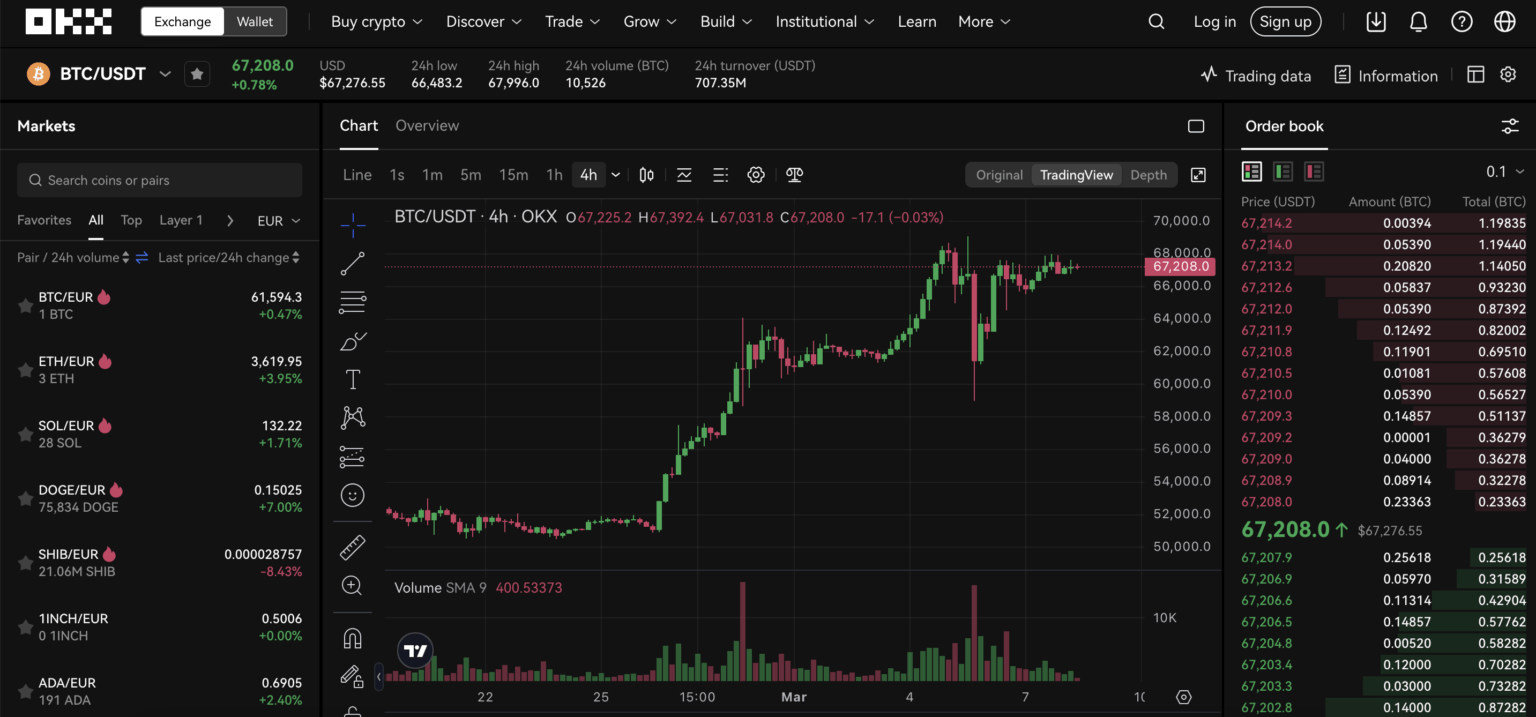
Execution reliability: CEXs historically win on raw latency and order‑type availability because centralized matching can be microsecond‑fast; Hyperliquid narrows that gap by moving matching on a trading‑optimized L1 with sub‑second finality and 0.07s blocks. AMM perps trade off order precision entirely. If your strategy depends on atomic multi‑order sequences and predictable fill behavior (e.g., laddered limit fills, TWAP with small slippage windows), Hyperliquid offers a closer match to CEX behavior while keeping custody non‑custodial.
Liquidity quality: CEXs still aggregate largest nominal liquidity. Hyperliquid’s approach uses user‑deposited vaults (LP vaults, market‑making vaults, liquidation vaults) and maker rebates to bootstrap and reward depth. That means liquidity can be tight for the core markets and more variable for niche contracts. AMM perps rely on automated curves and can suffer from inefficient pricing under large directional flows. If you trade major crypto, commodities, or indices — and especially now with 300+ markets live — Hyperliquid’s CLOB plus rebate model is designed to give you tighter spreads and order book depth than typical AMMs, though it may still trail the largest CEX on absolute depth for some exotics.
Fees and incentives: Hyperliquid eliminates gas fees and uses maker rebates plus low taker fees. For active makers and algorithmic traders, that is attractive: you avoid on‑chain gas tax and can receive rebates for providing passive liquidity. CEX fee tiers can be aggressive for volume, but they entail custody and counterparty concentration risk. AMMs often have lower nominal fees but implicit costs through price slippage and funding inefficiency.
Leverage and margining: Hyperliquid supports up to 50x leverage and both cross and isolated margin. Mechanically, cross margin reduces liquidation events at the cost of contagion risk across positions; isolated margin caps downside per position but requires active management. Hyperliquid’s atomic liquidation design and liquidation vaults aim to contain insolvencies swiftly, a structural advantage versus some on‑chain systems where slow settlement can cascade losses. CEXs have finely tuned liquidation engines but carry central counterparty risk; AMM perps’ leverage behavior depends on the specific protocol design and can be less predictable.
Composability and tooling: A crucial future advantage is HypereVM — a parallel EVM planned to allow external DeFi apps to compose with native Hyperliquid liquidity. Today, Hyperliquid already provides programmatic access through a Go SDK and extensive APIs. That levels the playing field for quant traders who want to deploy strategies without yielding custody. CEXs are less composable by design, and AMMs are composable but lack the CLOB primitives many algos require.
Transparency and on‑chain guarantees: This is Hyperliquid’s signature. A fully on‑chain CLOB with instant finality and explicit architecture to eliminate MEV puts trade logic, funding, and liquidations in verifiable state transitions — a substantial advantage when auditing performance or reconstructing fills after a disputed event. CEXs provide opaque internal order books; AMMs are transparent but their pricing mechanics differ fundamentally.
Where Hyperliquid shines — and where it doesn’t
Shines:
– Traders who need advanced order types and programmatic strategies without giving up non‑custodial ownership. Hyperliquid supports market, limit families, TWAP, scale orders, and more, plus a Go SDK and real‑time streams for low‑latency automation.
– Market makers and liquidity providers who can benefit from zero gas fees and maker rebates while supplying vault liquidity rather than betting against an AMM curve.
– Risk‑conscious traders who prize on‑chain auditability and atomic liquidations to reduce post‑event disputes.
Limits and open questions (be explicit):
– Aggregate depth vs top CEXs: while the platform supports 300+ markets and uses rebate incentives, absolute liquidity on some niche contracts may lag top centralized venues. This matters for very large ticket trades or certain derivatives on thin underlying markets.
– User experience edges: matching on a bespoke L1 is powerful but requires users and integrations to adopt new SDKs and APIs. Some institutional tooling built for standard CEX APIs may need adaptation.
– Roadmap risk: HypereVM integration is a promising composability signal, but it is a roadmap item; reliance on its eventual arrival should be treated as a conditional expectation, not a current guarantee.
Decision framework: three heuristics for US traders
Use these heuristics to choose whether to route a strategy to Hyperliquid or elsewhere.
1) If your strategy requires precise limit order placement, predictable fills, and on‑chain settlement (e.g., market‑making, laddered entries, algorithmic TWAP without custody tradeoffs), favor Hyperliquid. The on‑chain CLOB and programmatic APIs materially reduce operational risk compared to hybrid DEXs.
2) If your ticket size routinely exceeds displayed liquidity on DEX order books, and slippage cost dominates fees, favor a large CEX — but consider splitting execution and using Hyperliquid for portioned, auditable fills or post‑trade reconciliation.
3) If you depend on DeFi composability now (e.g., atomic interactions with other EVM protocols), evaluate the protocol’s current composability surface carefully: HypereVM promises improved composition in the future, but today HypereVM is a roadmap item and external composition routes are limited compared to native EVM chains.
Practical operations: how to test and monitor Hyperliquid markets
Walk before you run. Start with lower leverage, simulated runs, and API‑based dry tests. Use the Info API’s market and account methods and subscribe to the gRPC/WebSocket level data to replay fills and funding events in a local environment. Monitor funding rates vs external benchmarks — mismatches can indicate liquidity pressure or market segmentation. Watch maker rebate levels: those are both a liquidity incentive and a signal about latent book depth. Finally, monitor liquidation vault status and trading volume on the 300+ markets recently highlighted by the project; rising unique volume across derivatives signals stable demand, while concentration in a handful of markets could mean liquidity risk elsewhere.
For readers who want to explore directly, the platform public page with developer tools and market listings is available at hyperliquid. Use that as an operational starting point for API keys, SDK downloads, and market metadata.
What to watch next — conditional scenarios, not promises
Two conditional pathways will determine whether Hyperliquid becomes a default venue for advanced DeFi traders in the US. Scenario A (favorable): sustained liquidity growth in core markets, broad adoption of the Go SDK by automated trading shops, and timely HypereVM rollout. This would amplify Hyperliquid’s composability advantage and could shift more order flow from CEXs. Scenario B (constrained): liquidity remains fragmented, third‑party integrations lag, or regulatory frictions make high‑leverage non‑custodial derivatives harder to operate in US jurisdictions. In that case Hyperliquid is still a superior technical design, but narrower in practical usage for large institutional flow.
Signals to monitor: aggregate on‑chain order book depth across top 20 markets, maker rebate levels (they indicate willingness to supply passive liquidity), average filled order latency under peak conditions, and the roadmap progress of HypereVM. Changes in any of those metrics would be informative and can be measured via the platform’s streaming APIs and publicly visible vault states.
FAQ — common trader questions
Are on‑chain CLOBs slower than centralized matching engines?
Not necessarily. Traditional on‑chain CLOBs suffered from blockchain latency and gas costs. Hyperliquid’s custom L1 targets trading throughput (0.07s block times, high TPS) and zero gas fees, so on‑chain matching approaches centralized speeds while retaining auditability. That said, top‑tier CEXs may still have microsecond advantages; the practical difference depends on your strategy’s sensitivity to latency.
Is liquidation risk higher on a decentralized perp like Hyperliquid?
Hyperliquid’s architecture is designed to reduce liquidation uncertainty: atomic liquidations, dedicated liquidation vaults, and instant funding distributions lower the odds of delayed settlement and cascading insolvency. However, leverage itself is still risky. Cross margin introduces contagion across positions; isolated margin limits losses per position but requires active monitoring. The platform’s mechanics mitigate some operational risks but do not remove market risk from highly leveraged positions.
How do maker rebates and zero gas fees affect my P&L?
Zero gas fees lower execution cost per trade, especially for high-frequency strategies. Maker rebates can flip the economics for passive liquidity providers — rebates can offset spread capture limits and improve net P&L vs venues charging gas plus fees. But rebates are also a signal: high rebates may be required where natural liquidity is thin, which implies execution risk for large fills.
Can I run algorithmic strategies like HyperLiquid Claw on the platform?
Yes. The ecosystem includes HyperLiquid Claw, a Rust‑built AI trading bot using an MCP server; more broadly, the platform’s Go SDK, WebSocket/gRPC feeds, and Info API are designed for programmatic strategies. That said, live deployment requires careful testing of edge cases like partial fills, reorgs (which are less of a concern with instant finality), and funding payment timing.
Closing takeaway: Hyperliquid represents a third way that preserves the performance and order‑type richness traders expect from centralized venues while restoring on‑chain transparency and non‑custodial control. It is not a universal replacement for every trade or strategy, but for many algorithmic, market‑making, and transparency‑sensitive workflows — especially in a US context where custody and auditability matter — it deserves serious operational trials. Treat roadmap items and liquidity growth as active signals rather than guarantees, and always align leverage to the worst plausible market move, not to historical averages.