
OKX spot trading: a practical, security-first comparison for U.S. traders
Imagine you just logged into an exchange one morning to move funds into a new spot position and found a delisting announcement for one of the small-cap tokens you were holding. That concrete friction—forced markets, compliance changes, and the constant need to defend access—captures the daily operational stakes of trading on a modern crypto platform. For U.S.-based traders weighing OKX, understanding the mechanics of spot trading is inseparable from custody, login hygiene, and the platform’s mix of centralized and Web3 services.
This article compares two practical approaches a U.S. trader commonly considers on OKX: (A) using OKX as a custodial centralized exchange for active spot trading, and (B) using OKX’s non-custodial Web3 wallet and DEX aggregator for self-custody spot-like swaps. I’ll explain how each works, the security and regulatory trade-offs, where things break, and a short checklist you can use before you press “Buy” or “Withdraw.”
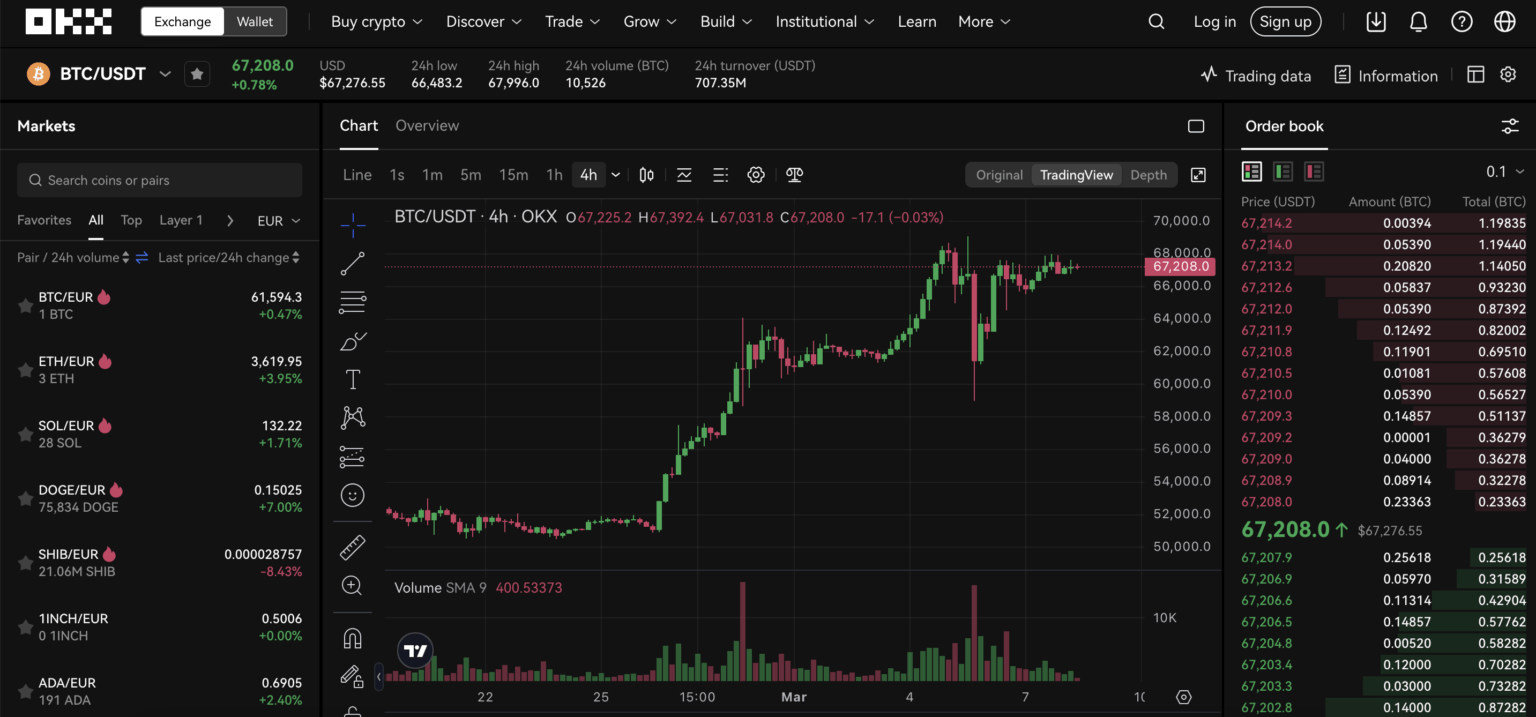
Two modes of using OKX: custodial CEX spot vs. self-custodial Web3 swaps
Mechanically, a custodial spot trade on OKX means you deposit assets into an account the exchange controls. Orders interact with OKX’s internal order book, matching with other users; settlement is an internal ledger update. By contrast, a self-custodial swap via the OKX Web3 wallet plus DEX aggregator routes trades through decentralized liquidity pools across chains, with on-chain settlement and the user’s private key signing transactions.
Why does this distinction matter? Because the primary risks, failure modes, and operational checks are different. With a custodial account you trade fast, access advanced tooling (TradingView charts, advanced order types), and can use margin or convert between fiat and stablecoins easily. However, custody concentrates counterparty risk: although OKX stores over 95% of assets in multi-sig cold storage and publishes Proof of Reserves, the security of your login and the exchange’s operational security still determine your practical risk exposure.
The Web3 route gives you control: your seed phrase and hardware-wallet integrations (Ledger, Trezor) determine who actually owns the coins. It reduces counterparty custody risk but introduces other hazards—seed phrase loss (permanent), phishing via fake dApp prompts, and smart contract exploits when the aggregator interacts with pools. The aggregator helps by routing across Uniswap-like liquidity to reduce slippage, but it can’t eliminate on-chain gas, bridging risk, or temporary pool illiquidity.
Login, identity verification, and the U.S. regulatory perimeter
OKX requires KYC to open trading accounts, including ID submission and facial liveness checks. For U.S. traders this is a decisive operational fact: custody-based account features (fiat on-ramps, margin, staking inside the exchange) require completed KYC. That process ties your ability to use the custodial platform to your government ID and to the exchange’s compliance workflows—so account access and reinstatement are governed by those policies.
From a security standpoint, OKX layers military-grade encryption, AI-driven threat detection for suspicious logins, and mandatory 2FA (Google Authenticator, SMS, or biometrics). Those are strong protections in principle. They are only as effective as the user’s operational discipline: reusing passwords, ignoring phishing indicators, or failing to bind 2FA gives attackers leverage, even against accounts protected by cold-storage policies.
If you need a refresher or to start the login process, OKX provides a dedicated login flow; U.S. users often follow an online guide tailored for the platform: okx login. Use that path as a step-by-step starting point, but treat the link as part of an operational checklist rather than an end in itself.
How security models change what you can reasonably do with spot trading
Custodial spot on OKX lets you use staking and yield products directly inside the exchange—flexible staking, lockups, and DeFi yield farming with auto-compounding are available. The convenience-tradeoff is clear: you trade away private-key control for smoother product access and usually lower friction when interacting with derivatives or margin. The exchange’s Proof of Reserves reduces opacity risk—users can verify backing on-chain—but it isn’t a substitute for private-key ownership.
Self-custody keeps you sovereign: you can connect to thousands of DApps, move across 130+ supported chains, and retain hardware-wallet protections. Yet these actions carry operational costs: you must manage seed backups, pay gas for cross-chain transfers, and accept the risk of smart contract bugs when leveraging DEX routes or yield farm contracts. In short, custody choice shapes the realistic trading strategy you can pursue without adding unacceptable operational overhead.
Where each model breaks — five specific failure modes to watch
1) Phishing and credential theft (custodial): sophisticated fake login pages and social engineering can bypass 2FA if users approve malicious device changes or OTP requests. The best mitigations are hardware-backed 2FA and transaction whitelisting where available.
2) Seed phrase loss or compromise (non-custodial): losing the seed means permanent loss; storing it on cloud or email is highly risky. Use hardware wallets and offline paper backups in secure physical locations.
3) Delistings and compliance actions (custodial): exchanges periodically delist low-liquidity pairs—the recent delisting of several spot pairs is routine. Delistings can force liquidations or difficult withdrawals if markets become thin; plan exit strategies for small-cap holdings.
4) Smart contract exploits (DEX aggregator): aggregated swaps reduce slippage but rely on external contracts. Audits help but don’t eliminate zero-day vulnerabilities. Limit exposure to newly deployed pools and avoid granting long-lived unlimited allowances when possible.
5) Liquidity and slippage (both modes, but especially non-custodial): large market orders on thin pairs cause slippage. Use limit orders on the CEX or split large on-chain swaps across multiple routes and times to minimize market impact.
Decision framework: which mode fits your objectives?
Use the following heuristic: if you prioritize speed, fiat access, margin, and institutional-style tooling—choose custodial spot on OKX. Expect better UX, staking-in-exchange, and access to derivatives, but accept that this requires KYC and relies on exchange-level security. If your priority is absolute control of private keys and interoperable Web3 access—choose the OKX Web3 wallet plus DEX aggregator. Expect higher operational demands and on-chain costs, but retain ultimate custody.
A practical hybrid approach is common: keep a capital base on the exchange for trading and fiat flows, and a separate self-custody wallet for long-term holdings and experimental DeFi positions. This spreads risk across custody models and aligns operational habits with financial goals.
Practical checklist before a spot trade on OKX (security-first)
– Verify domain and bookmarks; never follow unknown email links. Phishing is the dominant attack vector.
– Enable and prefer hardware-backed 2FA and confirm device approvals for withdrawals.
– For custodial trading, maintain withdrawal whitelist and small exchange exposure relative to total holdings.
– For Web3 swaps, use hardware wallets, set token allowances conservatively, and split large swaps to reduce slippage and MEV risk.
– Monitor liquidity and delisting notices—if you hold thin markets, have an exit plan before a forced delisting appears.
What to watch next — near-term signals and conditional scenarios
Regulatory scrutiny in the U.S. will continue to shape custodial service features and KYC friction. If regulation tightens, expect more robust identity checks and possibly restrictions on certain products for U.S. users—this would favor self-custody for privacy-sensitive traders. Conversely, if centralized platforms continue improving PoR transparency and third-party custody audits, the convenience advantage of custodial spot could strengthen.
Operational signals to monitor: new delisting cycles (they warn about low-liquidity pockets), changes in cold-storage practice or multi-sig thresholds, and upgrades to the DEX aggregator’s routing logic. Each of these shifts changes the marginal trade-off between safety and convenience.
FAQ
Is OKX safe for U.S. spot traders?
“Safe” depends on your threat model. OKX has strong platform security (cold storage, multi-sig, PoR, AI detection) and requires KYC for custodial features. For many U.S. traders the platform is operationally secure, but account-level practices (unique passwords, hardware 2FA) and exposure limits are decisive. If you need ultimate control, use the non-custodial Web3 wallet with a hardware device.
Should I keep all my trading funds on OKX or split custody?
Splitting is usually wiser. Keep actively traded funds on the exchange for liquidity and speed, and store long-term holdings in a self-custodial wallet or hardware wallet. This hedges against both exchange operational failures and user-side mistakes.
How do delistings affect spot traders?
Delistings remove trading pairs and may force withdrawals or conversions. They typically target low-liquidity assets; monitor notices and move positions preemptively. Delistings underscore a broader point: low-cap tokens carry structural liquidity risk beyond price volatility.
Can I stake through OKX safely while trading spot?
Yes—OKX supports flexible and fixed-term staking with auto-compounding. But staking inside a custodial exchange shifts custody risk to OKX. If you prefer both staking rewards and private-key control, look for on-chain staking through your Web3 wallet, accepting the extra operational overhead.
Bottom line: OKX offers a functional mix—powerful custodial spot trading with advanced tooling and a self-custodial Web3 path for users who want private-key sovereignty. The right choice depends on your priorities: convenience, regulatory access, and advanced order types favor the CEX; absolute control and cross-chain DeFi flexibility favor the Web3 wallet. Either way, treat login hygiene, 2FA, and liquidity awareness as non-negotiable operational disciplines—those are the mechanics that determine whether a trade is merely profitable on paper or actually realized without loss.
Sorry, the comment form is closed at this time.